10th Entrepreneurship Star Award Winner / Richten Energy Turns Solar Panels into Building Façades
Richten Energy 121
Economic Daily News
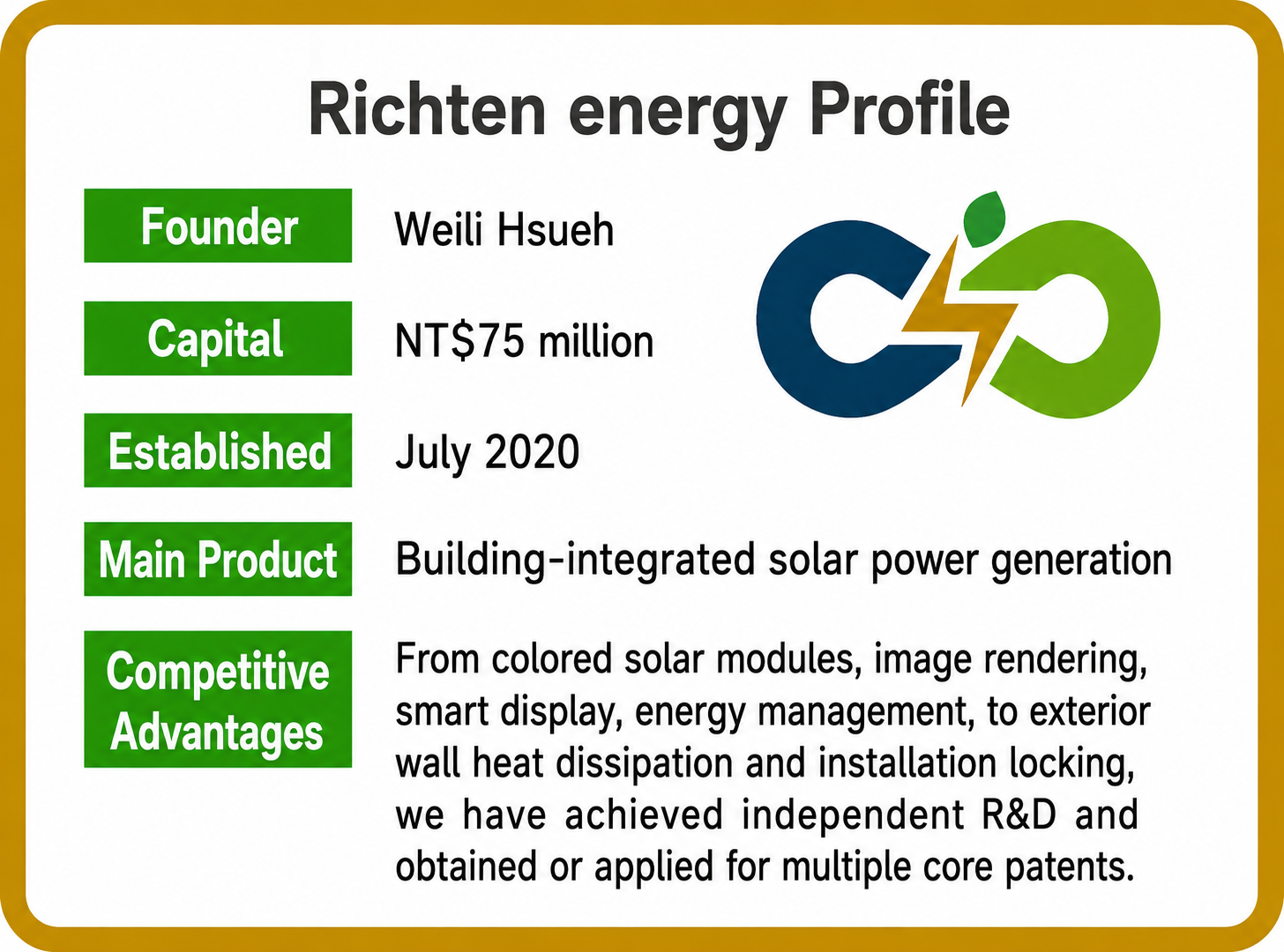
Richten Energy has combined solar façade technology with optical colour tuning, highly weather-resistant materials, specialised coating layers, proprietary fastening systems and structural design to transform solar panels from rooftop equipment into functional building façade materials. The company recently received an Excellence Award in the Company Category at the 10th Entrepreneurship Star Competition, organised by Economic Daily News.
“We are not simply selling a coloured solar panel,” said Weili Hsueh, Founder and Chief Executive Officer of Richten Energy. “We are developing the city’s next green-energy market — building façades.”
With a background in information technology, Hsueh previously ran a hospitality business called Wei Hsiang Hospitality. During the Covid-19 pandemic, he helped hotels attract customers by developing membership systems, enabling the business to grow against the wider industry downturn and achieve results that became well known within the sector.
As a holder of a sustainability and ESG strategy qualification associated with the United Nations Institute for Training and Research (UNITAR), Hsueh recognised that buildings represent one of the world’s largest sources of carbon emissions, second only to the power sector. This led him to explore how buildings could shift from being passive energy consumers to active energy generators. He subsequently moved into research and development, and in 2020 renamed Wei Hsiang Hospitality as Richten Energy.
Around the same period, then Minister of the Interior Lin Yu-chang helped launch the Taiwan Intelligent Zero-Carbon Building Alliance (TIZC). Hsueh was invited to serve as a supervisor of the alliance, bringing him into closer collaboration with industry, government, academia and research institutions in support of Taiwan’s goal of achieving net-zero buildings by 2050. The alliance was established in September 2023 and was initiated by then Presidential Office Secretary-General Lin Chia-lung and launched by then Minister of the Interior Lin Yu-chang.
Hsueh said that in 2023, COP28, the United Nations Climate Change Conference, agreed on a global push to expand renewable energy. For Taiwan, an island with limited land available for further development, he believes there is only one direction left to grow: upwards. That constraint, he said, creates an opportunity for buildings themselves to become energy-generating assets.
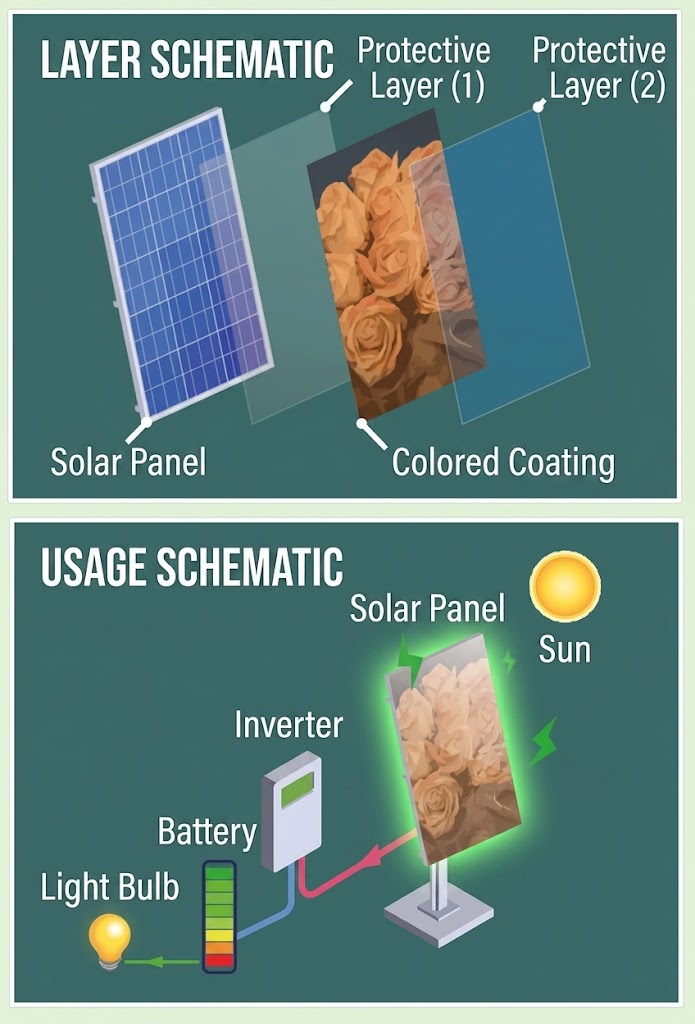
Power-Generating Advertising Walls Open Up New Revenue Opportunities
Richten Energy is not tackling a single R&D problem. It faces three interconnected challenges: market acceptance, engineering and scalability.
Building owners, architects, contractors, regulators and financial decision-makers all need to accept the concept. As a result, the company cannot rely on a single material or a marketing slogan. It needs an engineering system that can be tested, installed and maintained in real-world buildings.
After more than a year of R&D, Richten developed technologies spanning customised coloured surface layers, optical colour tuning, highly weather-resistant materials, façade fastening systems, structural design, electrical integration and energy monitoring.
Together, these technologies form a solar façade system that enables exterior walls to provide multiple functions at once: electricity generation, shading, thermal insulation, low glare, brand visibility and carbon-reduction reporting.
Beginning in 2024, Richten secured Phase I and Phase II on-site demonstration projects with the Architecture and Building Research Institute (ABRI), Ministry of the Interior, allowing the institute to accumulate field data across the two phases.
Hsueh said buildings have traditionally been regarded as a cost centre, but Richten’s technology is challenging that assumption and creating a new revenue model.
“The completion of a building should not be the end,” he said. “It should be the point at which the building starts generating value.”
The first potential revenue stream is advertising. Solar façade materials can turn buildings into power-generating advertising walls. Buildings in high-visibility locations with strong footfall or traffic can potentially generate a recurring advertising income while producing electricity at the same time.
The second is direct renewable electricity supply. Rather than relying solely on electricity supplied through Taiwan Power Company, renewable electricity generated by buildings can potentially be supplied to listed companies seeking to meet ESG and renewable-energy requirements.
At the same time, the model creates a new principle of “generation as revenue”. Certificates associated with self-generated renewable electricity may create additional environmental value, giving companies another potential source of income while helping them respond to carbon-reduction requirements.
Of particular significance is Taiwan’s Standards for the Installation of Solar Photovoltaic Power Generation Equipment on Buildings, which took effect on 1 August 2026. In principle, newly constructed, extended or reconstructed buildings with a building area of at least 1,000 square metres are required to install 1 kW of solar PV capacity for every 20 square metres of applicable building area. The Ministry of the Interior estimates that the measure could add approximately 660 MW of solar capacity each year. The policy provides a further tailwind for Richten as it expands its technology into overseas markets.
Policy Tailwinds Support Richten’s International Expansion
Richten has recently accelerated its international expansion.
In May this year, the company signed a Letter of Intent on Smart Net-Zero Buildings and Clean Technology Cooperation in Taiwan with Kansas Lieutenant Governor and Secretary of Commerce David Toland. In early July, Ford County in Kansas approved a budget involving the deployment of Richten’s technology, paving the way for local testing and demonstration.
Hsueh has also taken part in a three-month entrepreneurship programme linked to the Nasdaq Entrepreneurial Center. He later joined a New York programme with representatives associated with Asia Innovation Hub (AIH) and the Nasdaq Entrepreneurial Center, participating in visits to financial institutions and capital-market exchanges as part of preparations for Richten’s further expansion into the US market.
Richten has also been building its presence in Europe.
In June, Paris hosted VivaTech, one of Europe’s major technology and innovation events. Taiwan Tech Arena (TTA) showcased a group of Taiwanese technology start-ups at its Taiwan Pavilion, highlighting Taiwan’s growing innovation presence in the European market.
Richten used the event to present its solar façade technology as a new form of net-zero infrastructure, demonstrating how building façades can be transformed from passive exterior surfaces into energy-generating assets.
The company was also selected for the first cohort of TTA x VivaTech 2026, giving it access through the TTA platform to European companies, investors and the wider international innovation ecosystem.
(The share action will open in a new window.)